

 Rebecca Cruz
 BlackRock enters DeFi with Uniswap to offer institutional investors access to tokenized Treasury trading, marking a major milestone in onchain finance and institutional DeFi adoption.
BlackRock Enters DeFi as Wall Street’s Largest Asset Manager Joins Uniswap
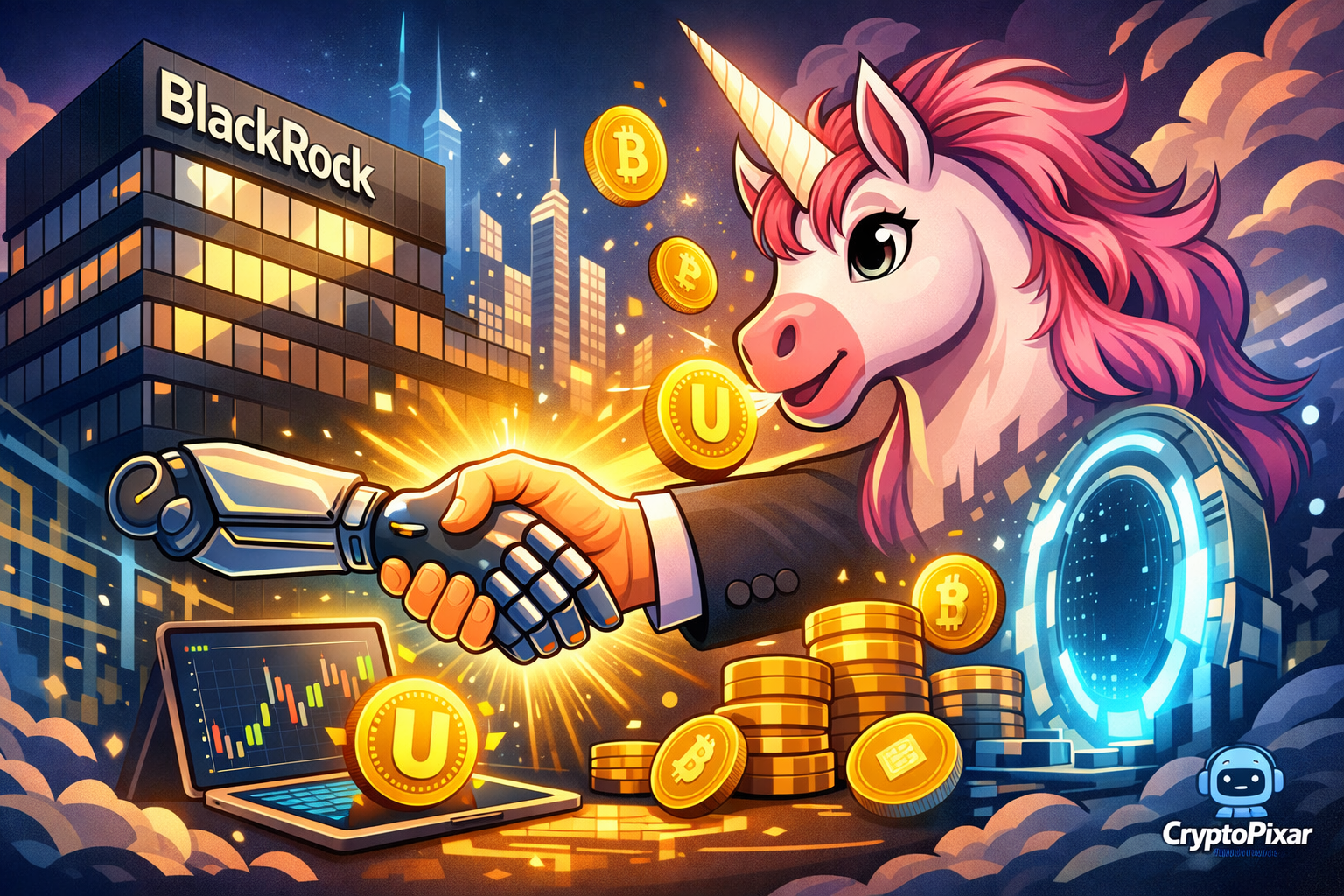
BlackRock enters DeFi with a bold move that bridges the gap between traditional finance and onchain innovation. The world’s largest asset manager has listed its $2.1 billion tokenized Treasury fund, the USD Institutional Digital Liquidity Fund (BUIDL), on Uniswap. This marks the first time a major Wall Street institution has brought a regulated tokenized product to a decentralized exchange.
The listing allows institutional investors to trade tokenized U.S. Treasuries directly on Uniswap, signaling a deepening embrace of decentralized finance. The collaboration, powered by Securitize, extends the reach of BlackRock’s BUIDL fund, offering institutions an opportunity to participate in DeFi using compliant onchain infrastructure.
Securitize CEO Carlos Domingo called the move a historic step for institutions exploring blockchain technology. He emphasized that approved investors can now access decentralized protocols for trading tokenized real world assets while maintaining self-custody of their holdings.
BlackRock’s Institutional Leap into Decentralized Finance
BlackRock enters DeFi not as an experiment but as a clear strategic expansion. The BUIDL fund already stands as the largest tokenized money market vehicle globally, managing more than $2.18 billion in assets. The fund operates across several blockchains including Ethereum, Solana, BNB Chain, Aptos, and Avalanche, illustrating BlackRock’s multi chain approach to liquidity and accessibility.
According to data from RWA.xyz, the fund surpassed $100 million in cumulative Treasury distributions in late 2025. The decision to bring this fund to Uniswap introduces a new chapter in institutional finance, where regulated products meet permissionless markets.
Initially, trading will be limited to a select group of qualified institutional investors and market makers before expanding to a wider pool of whitelisted participants. By leveraging Uniswap’s automated liquidity infrastructure, institutions can execute trades onchain while complying with regulatory standards.
As part of the arrangement, BlackRock also acquired an undisclosed amount of Uniswap’s governance token, UNI, underscoring its long term commitment to decentralized governance participation.
Wall Street’s Race to Tokenize Real World Assets
BlackRock enters DeFi at a time when tokenized money market funds are gaining traction among major financial institutions. The push for tokenization is part of a broader trend that includes Goldman Sachs and BNY Mellon, both of which are exploring blockchain based frameworks for institutional clients.
This shift reflects a growing recognition that decentralized finance offers efficiency, transparency, and around the clock market access that traditional systems cannot match. The success of BUIDL demonstrates that blockchain is moving beyond crypto speculation into practical, yield bearing financial products.
Analysts from JPMorgan have noted that tokenized money market funds could serve as a counterweight to the rapid rise of stablecoins. While both rely on blockchain technology, the key difference lies in their underlying collateral and regulatory structure. Tokenized Treasuries such as BUIDL provide exposure to real world assets while maintaining compliance, making them attractive to risk conscious institutions.
The GENIUS Act, which aims to formalize stablecoin regulations in the United States, could accelerate this evolution even further. Clearer regulatory frameworks are expected to boost confidence among institutions and pave the way for large scale onchain financial adoption.
A Turning Point for Institutional Onchain Finance
BlackRock enters DeFi not just as a participant but as a catalyst for the future of finance. The partnership with Uniswap symbolizes a merging of two worlds—Wall Street’s vast capital and DeFi’s permissionless technology. This integration could redefine how liquidity, collateral, and transparency operate within global financial systems.
The move also underscores a new institutional narrative. In previous years, traditional finance viewed DeFi with caution. Today, institutions are not only engaging with DeFi protocols but shaping their evolution. BlackRock’s tokenized Treasury offering represents a tangible example of how regulated investment products can thrive within decentralized ecosystems.
As tokenization continues to reshape financial markets, experts predict an acceleration in the creation of blockchain based funds, collateral solutions, and real world asset marketplaces. Solomon Tesfaye of Aptos Labs believes that institutional involvement from players like BlackRock could trigger a domino effect, driving mainstream adoption of onchain finance.
For Uniswap, this partnership validates its role as a leading decentralized trading hub capable of handling complex, institution grade transactions. For BlackRock, it signals the beginning of a larger strategy to embed blockchain technology within its global investment infrastructure.
Disclaimer: Parts of this article were generated with the assistance from AI tools and reviewed by our editorial team to ensure accuracy and adherence to our standards.