


 Rebecca Cruz
 Deloitte confirms Anchorage Digital’s $17.6 million reserves for Tether’s USAT stablecoin, marking the first Big Four attestation linked to Tether under the new GENIUS Act framework.
Deloitte Confirms Anchorage Reserves Behind Tether’s USAT Stablecoin
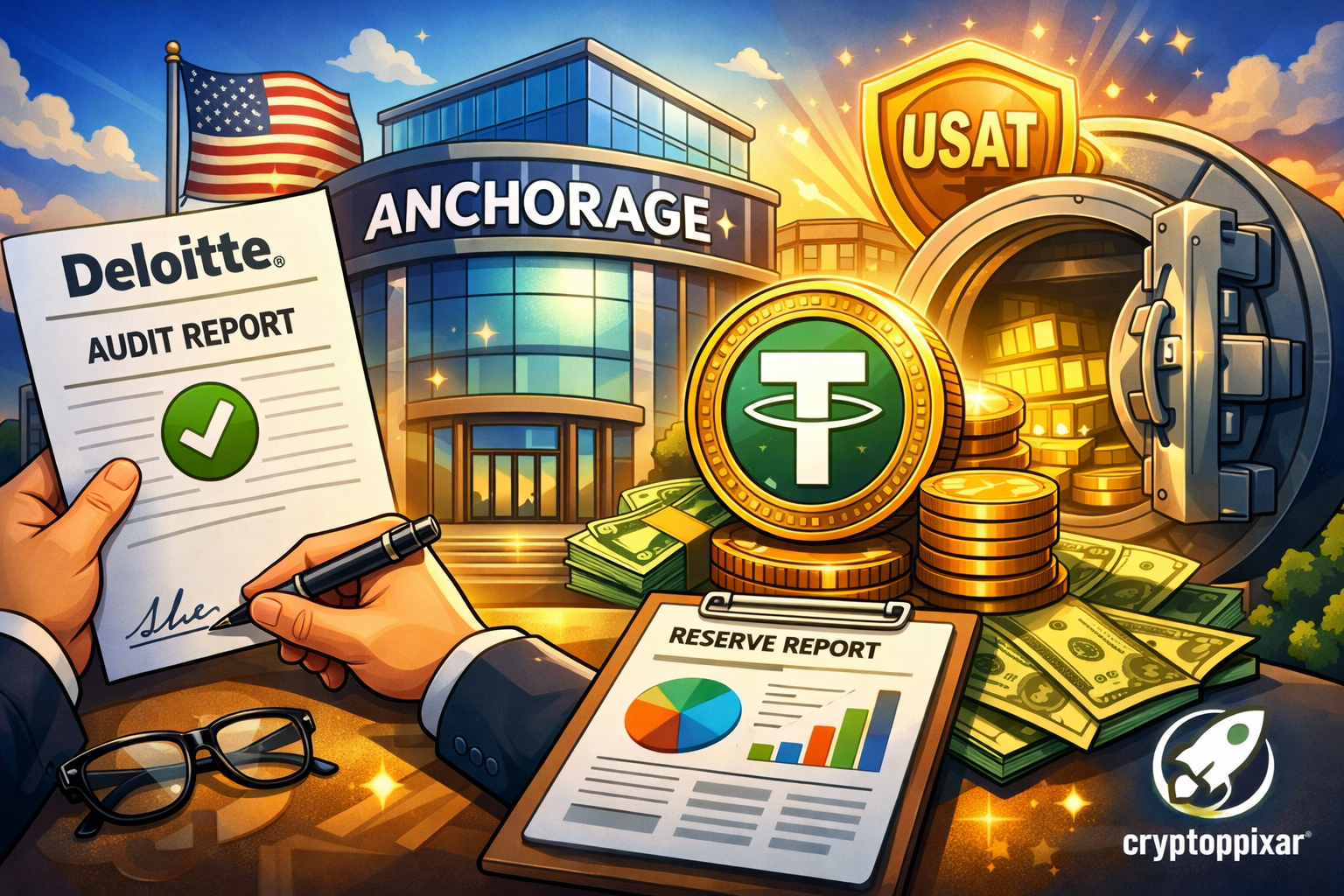
In a landmark moment for the stablecoin industry, Deloitte has officially validated the reserve report for Tether’s USAT stablecoin, confirming $17.6 million in backing assets held by Anchorage Digital Bank. The attestation marks the first time a Big Four accounting firm has verified reserves associated with Tether, signaling a new era of institutional transparency for the stablecoin sector.
The USAT stablecoin, launched in January 2026, operates on Ethereum and is fully regulated under the GENIUS Act the United States’ federal framework introduced in mid-2025 to standardize fiat-backed digital assets. Deloitte’s confirmation reinforces growing confidence in regulated stablecoins, particularly those built to meet stringent compliance and attestation requirements.
Deloitte’s Independent Attestation Adds Institutional Weight
According to Deloitte’s report dated February 27, 2026, the firm reviewed Anchorage’s reserve statement in line with the American Institute of Certified Public Accountants’ updated standards for fiat-backed digital tokens. The attestation covered reserves as of January 31 and verified Anchorage’s management assertion that the USAT stablecoin reserve report was fairly stated in all material respects.
Anchorage disclosed that 17.5 million USAT tokens were in circulation at the reporting date, fully backed by $17.6 million in assets. The reserve composition included $3.65 million in cash and $13.95 million in short-term reverse repurchase agreements collateralized by US Treasury securities. These assets were held with a US broker-dealer and structured to mature within a few days, ensuring liquidity and security for token holders.
The surplus of approximately $103,000 above outstanding liabilities underlines Anchorage’s commitment to maintaining conservative reserve management practices. Deloitte’s sign-off, though limited to attestation rather than a full financial audit, still marks a significant step toward higher transparency standards across the industry.
A Regulatory Milestone for the USAT Stablecoin
The USAT stablecoin stands out for being among the first to fully align with the GENIUS Act, which was enacted to regulate asset-backed digital currencies within the United States. This compliance framework mandates strict reporting, redemption guarantees, and independent verification of reserves all of which Anchorage has implemented from the onset.
The attestation from Deloitte serves as external validation that USAT’s reserves not only exist but are appropriately structured and safeguarded. Each USAT token maintains a one-to-one peg to the US dollar and remains fully redeemable. The report explicitly stated that there are no nonredeemable or temporarily restricted tokens, reinforcing user trust in the asset’s stability.
This approach differentiates USAT from many stablecoins that have historically faced criticism for opaque reserve disclosures or reliance on internal attestations. With a Big Four firm now confirming its reserves, USAT is positioning itself as a benchmark for compliance-first stablecoin design in a post-regulatory era.
Stablecoin Market Heads Toward Trillion-Dollar Expansion
Beyond the Deloitte attestation, the broader stablecoin market continues to attract attention from global financial institutions. Standard Chartered recently reaffirmed its projection that the stablecoin sector will expand to $2 trillion by 2028, despite temporary slowdowns in issuance volumes across major tokens.
While the market currently sits near $300 billion in total capitalization, analysts view the recent contractions in Tether’s USDt and Circle’s USDC as cyclical rather than structural. Tether’s flagship USDt supply fell by $1.5 billion in February, following a $1.2 billion reduction in January. The company attributed these declines to short-term liquidity adjustments and distribution realignments rather than diminishing adoption.
Amid these shifts, USAT’s transparent and regulated framework could serve as a model for the next phase of stablecoin evolution, one driven by compliance, assurance, and institutional acceptance. The backing from a Big Four auditor elevates the credibility of Anchorage’s product and highlights the increasing importance of external oversight in a maturing digital asset landscape.
The Road Ahead for Tether’s USAT
For Tether and Anchorage, Deloitte’s attestation represents both a reputational milestone and a strategic signal to regulators and investors. It shows that the USAT stablecoin can coexist within the boundaries of US financial law while still providing the efficiency and programmability of blockchain-based settlement.
As market scrutiny intensifies, such independently verified stablecoins could become the preferred instruments for institutional finance, cross-border payments, and tokenized asset markets. The convergence of accounting transparency, federal regulation, and blockchain innovation points toward a future where digital dollars gain mainstream legitimacy.
With Deloitte’s stamp of approval, Anchorage and Tether have not only secured compliance credibility but also set a new precedent for what accountability in stablecoin issuance should look like. The USAT stablecoin now stands as a case study for how regulatory clarity and professional assurance can drive confidence in the next generation of digital assets.
Disclaimer: Parts of this article were generated with the assistance from AI tools and reviewed by our editorial team to ensure accuracy and adherence to our standards.