


 Tom Kushner
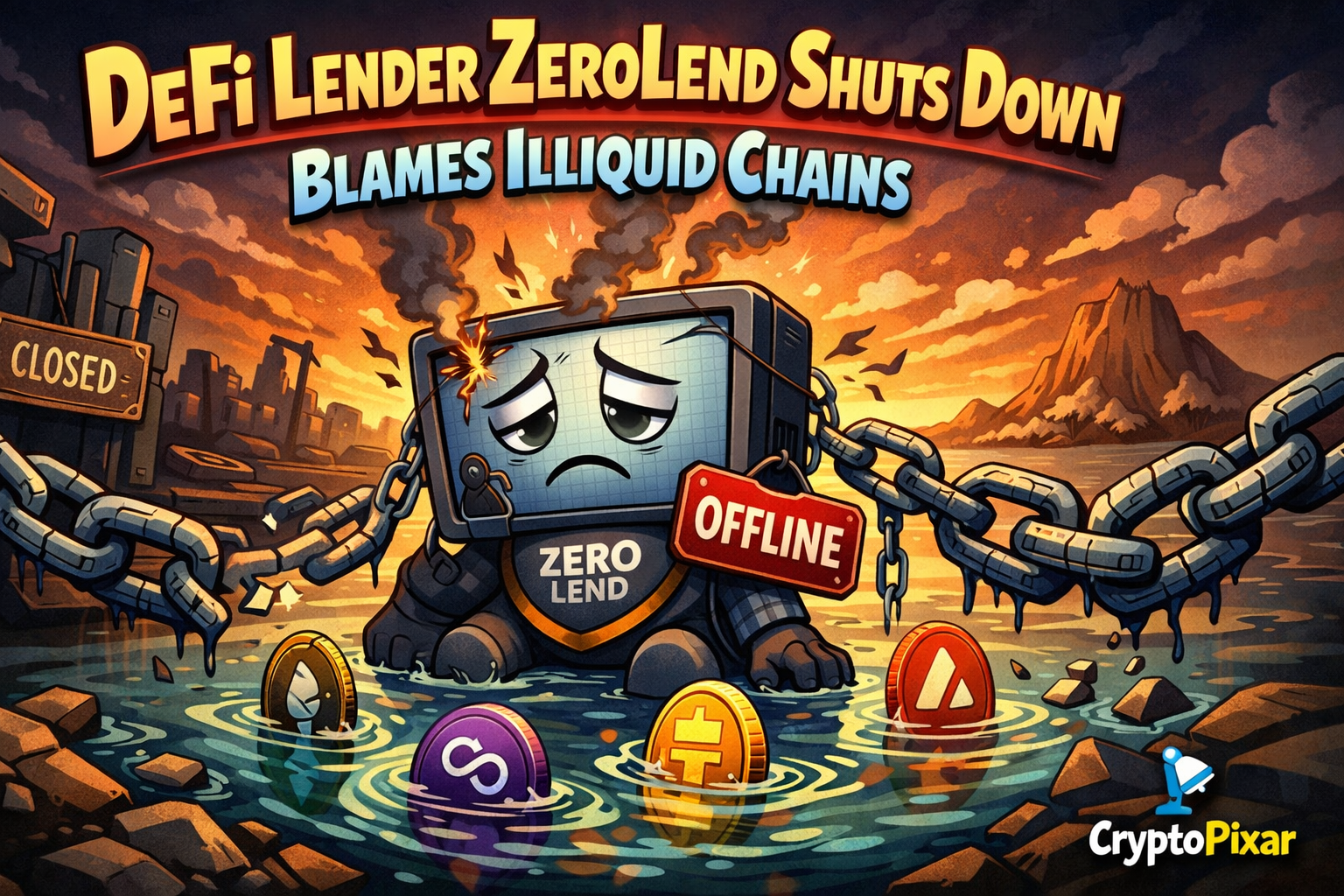
 DeFi lender ZeroLend shuts down after struggling with illiquid chains and inactive networks, highlighting deeper liquidity challenges across decentralized finance platforms.
ZeroLend’s Exit Marks a Turning Point for DeFi
The decentralized finance ecosystem has witnessed another major shakeup as ZeroLend, once a promising DeFi lending protocol, officially announced its complete shutdown. The team behind the project cited illiquid chains, inactive networks, and an unsustainable operating model as the primary reasons for the closure.
Founded in 2021 by the pseudonymous developer Ryker, ZeroLend emerged as a multi-chain DeFi lender that aimed to democratize access to decentralized credit markets across Ethereum layer 2 networks. However, after three years of development, Ryker confirmed that the project could no longer maintain financial stability due to a combination of liquidity droughts and infrastructural challenges across its supported blockchains.
This development comes at a time when the DeFi sector is undergoing an identity crisis, with liquidity fragmentation and declining user participation raising concerns about the long-term viability of smaller protocols.
Illiquid Chains and Oracle Failures Crippled ZeroLend
In a statement shared on X, Ryker explained that ZeroLend’s downfall was largely triggered by several supported blockchains becoming inactive or illiquid. These chains, once seen as the future of scalable DeFi, gradually lost developer support and trading activity, leaving lending pools stranded.
The absence of liquidity meant that users were unable to efficiently borrow or lend assets, forcing the protocol to operate at a loss for extended periods. Adding to the challenges, some oracle providers discontinued their services on these chains, disrupting essential price feeds that DeFi platforms rely on to function securely.
Ryker noted that without consistent oracle data, maintaining reliable lending markets became nearly impossible. This reliability gap eroded user trust and compounded the financial strain on the protocol.
Despite attempts to adapt, including potential integrations with other chains and revised fee structures, ZeroLend ultimately found itself trapped in a cycle of declining liquidity and rising operational costs.
Security Strains and High Risk Profile Deepen DeFi Troubles
Ryker also pointed out that as ZeroLend grew in visibility, it became an increasingly attractive target for malicious actors. The protocol faced continuous pressure from exploits, phishing attempts, and other attacks that eroded user confidence and drained resources.
The combination of thin profit margins and constant security threats has become a common pattern in the DeFi lending landscape. With competition intensifying and returns shrinking, maintaining profitability while ensuring robust security has become a near-impossible balancing act for smaller protocols.
ZeroLend’s case illustrates how DeFi’s open architecture can also be its greatest vulnerability. Every integration and dependency whether with oracles, bridges, or secondary chains introduces additional attack surfaces. When one link in the chain breaks, the ripple effects can paralyze entire ecosystems.
Users Urged to Withdraw Funds as Liquidity Evaporates
As part of the shutdown process, ZeroLend has urged all users to withdraw their remaining assets immediately. However, the team admitted that some funds may be locked on blockchains that have suffered severe liquidity deterioration.
To mitigate losses, the protocol will upgrade its smart contracts to redistribute any recoverable assets to affected users. Ryker also confirmed that efforts are underway to recover funds from a previous exploit on the Base blockchain, which impacted ZeroLend’s Bitcoin-linked product.
In a gesture to partially compensate victims of that incident, the team will distribute a refund funded by an airdrop allocation previously received by the ZeroLend developers.
DeFi Market Reacts as ZeroLend Token Plummets
Market reaction to ZeroLend’s announcement was swift and severe. The ZeroLend (ZERO) token plunged 34% within 24 hours of the shutdown confirmation, extending a long-term decline that has seen the token lose nearly all of its peak value since May 2024.
According to DeFiLlama data, ZeroLend’s total value locked has crashed from a high of approximately $359 million in November 2024 to just $6.6 million at the time of shutdown. This decline mirrors a broader trend across DeFi, where multiple protocols have seen liquidity dry up amid waning investor enthusiasm.
The collapse underscores how liquidity fragmentation and unsustainable multi-chain strategies continue to challenge DeFi’s growth narrative.
What ZeroLend’s Fall Means for the Future of DeFi
ZeroLend’s exit raises broader questions about DeFi’s direction and the sustainability of layer 2 ecosystems. Ethereum co-founder Vitalik Buterin recently acknowledged that many layer 2 networks have failed to fully adopt Ethereum’s security model, prompting a renewed focus on scaling directly through the mainnet and native rollups.
This shift may signal a consolidation phase where capital and innovation migrate toward a smaller number of secure and liquid platforms, leaving smaller DeFi projects like ZeroLend vulnerable to extinction.
As the DeFi landscape matures, the ZeroLend story serves as a stark reminder that liquidity remains the lifeblood of decentralized finance. Without consistent user activity, strong infrastructure, and security resilience, even the most well-intentioned protocols can face sudden collapse.
Disclaimer: Parts of this article were generated with the assistance from AI tools and reviewed by our editorial team to ensure accuracy and adherence to our standards.